
Advanced Full Stack Python with AI, ML & Data Science Professional Program
Master end-to-end development and cutting-edge data technologies by learning full stack Python development alongside Artificial Intelligence, Machine Learning, and Data Science. Gain hands-on experience with Django/Flask, databases, modern web frameworks, Python libraries for AI/ML, and real-world data projects to build versatile, job-ready skills for both web development and intelligent applications.
Professional Certification
Upon successful completion, you will receive an industry-recognized credential.
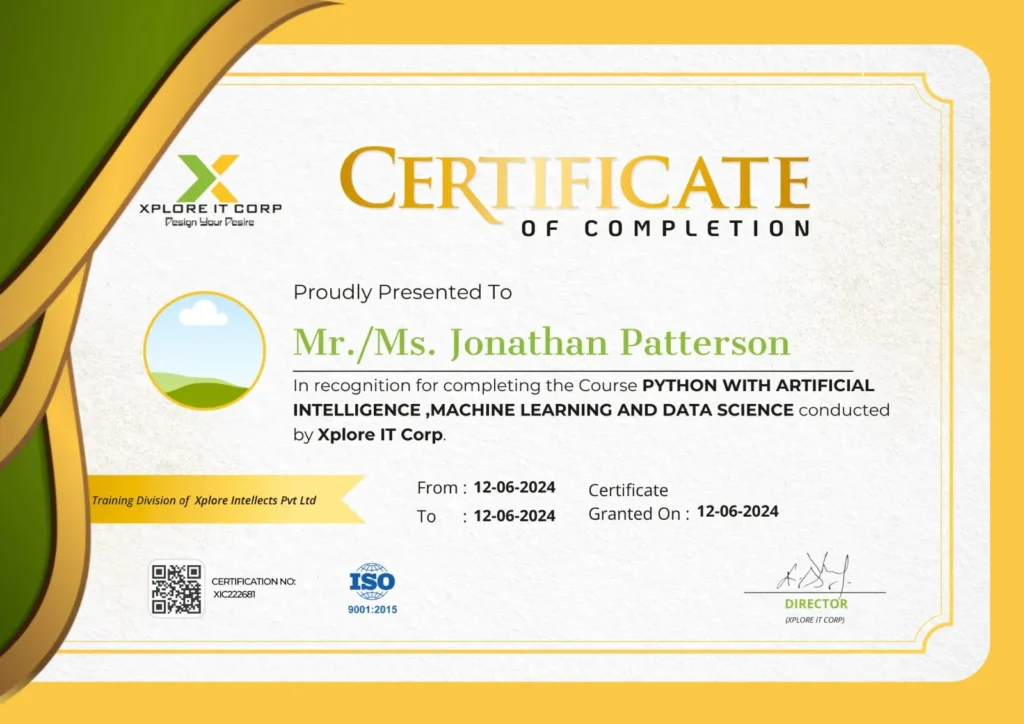
Industry-Validated Certification
Accredited by the Global Data Science Alliance and recognized by top tech employers worldwide.
Digital Verification
Includes a unique blockchain-verified ID that can be added directly to your LinkedIn profile.
Completion Criteria
Awarded upon submission of all 5 capstone milestones and passing the final technical assessment.

Gobinath Arumugam
Full Stack Python Expert | Software Development Trainer
With a strong background in full stack development and data technologies, Gobinath Arumugam brings a practical, results-driven approach to Python Full Stack with AI, ML & DS, simplifying complex concepts into clear, structured, and job-ready skills.
Focused on transforming Python and AI/ML expertise into real-world applications through hands-on projects, intelligent systems, backend frameworks, and database integration.
13+ Years
at Xplore IT Corp
150+
Institutions Reached
2000+ Batches
Trained Across India
50000+
Students Trained








Course Syllabus
A comprehensive 12-week journey from basics to professional mastery.
- C & C++ Programming
- HTML, CSS, JavaScript, Bootstrap
- What can Python do?
- Why Python
- Python Syntax in comparison to other Programming Languages
- Python Installation
- Compilation and Interpretation
- Path Configuration
- Python Data Structures & Data Types
- String Operations in Python
- Simple Input & Output
- Operators in Python
- DECISION MAKING
If – If Else
Else If Nested - LOOPING
For
While
Nested Loops
- Create your own Function
- User defined and System defined functions
- Variable Argument
- Scope of Function
- Lambda Function & Map
- Exercise with Functions
- Errors
- Exception handling with try
- Handling Multiple Exceptions
- Writing your own Exception
- New Style Classes
- Creating Classes
- Constructor
- Instance Methods
- Inheritance
- Polymorphism
- Abstraction
- Encapsulation
- Exception Classes
- List Comprehensions
- Nested List Comprehensions
- Dictionary Comprehensions
- Tuples
- Iterators
- Generators
- With Statement
- Data Comprehension
- Namedtuple()
- Deque
- Chainmap
- Counter
- Dict and Types
- Introduction
- Components and Events
- An Example GUI
- The root Component
- Widgets
- Buttons
- Introduction
- Hello World
- Major Classes
- Using Qt Designer
- Signals & Slots
- Layout Management
- Basic Widgets
- Drag & Drop
- Database Handling
- Introduction DB Connection
- Creating DB Table
- INSERT, READ, UPDATE, DELETE Operations
- COMMIT & ROLLBACK Operation
- Handling Errors
- GUI With Sqlite3
- Desktop Application
- Random
- Turtle
- File Input & Output
- Time & Date etc.
- Split
- Working with Special Characters, Date, Emails
- Quantifiers
- Match and Find all
- Characters sequence and substitute
- Search Method
- Set
- Introduction
- Socket – Introduction
- Clients and Servers
- The Client Program
- The Server Program
- Class and Threads
- Multi-Threading
- Threads Life Cycle
- Use Cases
- Introduction
- Learning Programming
- Core Language
- Text editors and IDEs
- Sublime Text
- PyCharm
- Jupyter Notebook
- Environment Configuration
- Virtual Environments
INTRODUCTION TO DJANGO
- Django Installation
- Creating Project
- Usage of Project in Depth
- Creating an Application
- Creating Hello World Page
- Database and Views
- Static Files and Forms
- Adding Models
- Django Model Classes
- Manage.py
- Database Commands
- The Admin Interface
- The model API
- Save and Delete
- Database Relations
- Adding HTML form
- Using Django Forms
- Fields Options
- Named Groups
- Named Groups in URL’s
- API and Security
DJANGO REST FRAMEWORK
- RDBMS
- MySQL
- Sqlite3
- Introduction
- Environment
- Routing
- Variable rule
- URL Building
- SQL Alchemy
- Set up a Python environment and install Django
- Create a Django Project
- Configure your Django application for Elastic Beanstalk
- Deploy your site with the EB CLI
- Update your Application
OPENCV 3 IMAGE AND VIDEO PROCESSING WITH PYTHON
- The core: Image- load, convert and save
- Smoothing Filters A – Average, Gaussian
- Smoothing Filters B – Median, Bilateral
- OpenCV 3 with Python
- Image – OpenCV BGR: MatplotLIB
- Basic image operations – pixel access
- iPython – Signal Processing with NumPy
- Signal Processing with NumPy I – FFT and DFT for sine, square
waves, unitpulse, and random signal - Signal Processing with NumPy II – Image Fourier Transform: FFT&
DFT - Inverse Fourier Transform of an Image with low pass filter: cv2.idft()
- Image Histogram
- Video Capture and switching colour spaces – RGB / HSV
- Adaptive Thresholding – Otsu’s clustering-based image thresholding
- Edge Detection -Sobel and Laplacian Kernels
- Canny Edge Detection
- Watershed Algorithm: Marker-based Segmentation I
- Watershed Algorithm: Marker-based Segmentation II
- Image noise reduction: Non-local Means denoising algorithm
- Image object detection: Face detection using Haar Cascade
Classifiers - Image segmentation -Foreground extraction Grabcut algorithm
based on graph cuts - Image Reconstruction – Inpainting (Interpolation) – Fast Marching
- Video: Mean shift object tracking
- Installation
- Features and feature extraction – iris dataset
- Machine Learning Quick Preview
- Data Preprocessing I- Missing/Categorical data
- Data Preprocessing II- Partitioning a
- Selection / Regularization dataset/Feature Scaling/Feature
- Data Preprocessing III– Dimensionality Reduction vs Sequential
Feature - Selection/Assessing Feature importance via random forests
- Data Compression via Dimensionality Reduction I – Principal
- Component Analysis (PCA)
Data - Compression via Dimensionality Reduction II- Linear
- Discriminant Analysis (LDA)
- Data Compression via Dimensionality Reduction III – Nonlinear
mappings via kernel principal component (KPCA) analysis - Logistic Regression, Overfitting & regularization
- Supervised Learning & Unsupervised Learning – e.g. Unsupervised
PCA - Dimensionality reduction with iris dataset
- Unsupervised Learning -KMeans clustering with iris dataset
- Linearly Separable Data -Linear Model & (Gaussian)radial basis
function kernel (RBF kernel) - Decision Tree Learning I – Entropy, Gini, and Information Gain
- Decision Tree Learning II – Constructing the Decision Tree
- Random Decision Forests Classification
- Support Vector Machines (SVM)
FLASK WITH EMBEDDED ML
- Serializing with pickle & DB setup
- Basic Flask App
- Embedding Classifier
- Deploy
- Updating the Classifier
- Batch Gradient Algorithm
- Perceptron model on the Iris Dataset using Heaviside step Activation
- Batch Gradient Descent Vs Stochastic Gradient Descent
- Adaptive Linear Neuron using linear activation function with – batch
gradient descent method - Adaptive Linear Neuron using linear activation function with –
- stochastic gradient descent (SGD)
- Logistic Regression
- VC (Vapnik – Chervonenkis) Dimension & Shatter
- Bias – Variance trade off
- Maximum Likelihood Estimation (MLE)
- Neural Networks with backpropagation for XOR using one hidden
- layer Min Hash
- tf-idf weight
- Natural Language Processing (NLP)
- Sentiment Analysis
- IMDb & bag-of-words
- Tokenization, Stemming & stop words
- Training & Cross Validation
- Out-of-Core
- Reinforcement Learning
- Reinforcement Learning Basics
- Approximation of methods in RL
- Case Studies Examples – RL
- Model Training &
- Deployment using AWS
- Deploying Machine Learning Model
- Training Machine Learning Model
- Forward propagation
- Gradient descent
- Backpropagation of errors
- Checking Gradient
- Training via BFGS
- Overfitting & Regularization
- Deep Learning – PYTORCH & KERAS
- Practical Application of Deep Learning in predicting Loan Default
- Backward Propagation in Pytorch
- Preparing datasets in Pytorch
- Keras functional API
- Classification Layers
- Training with Fit Generator
- Image Recognition (Image Uploading)
- Image Recognition (Image Classification)
- Theano, TensorFlow