
Embedded Systems Professional Program
Master core embedded system concepts, microcontroller architectures, and real-time programming through hands-on labs and real-world hardware projects to build industry-ready embedded engineering skills.
Professional Certification
Upon successful completion, you will receive an industry-recognized credential.
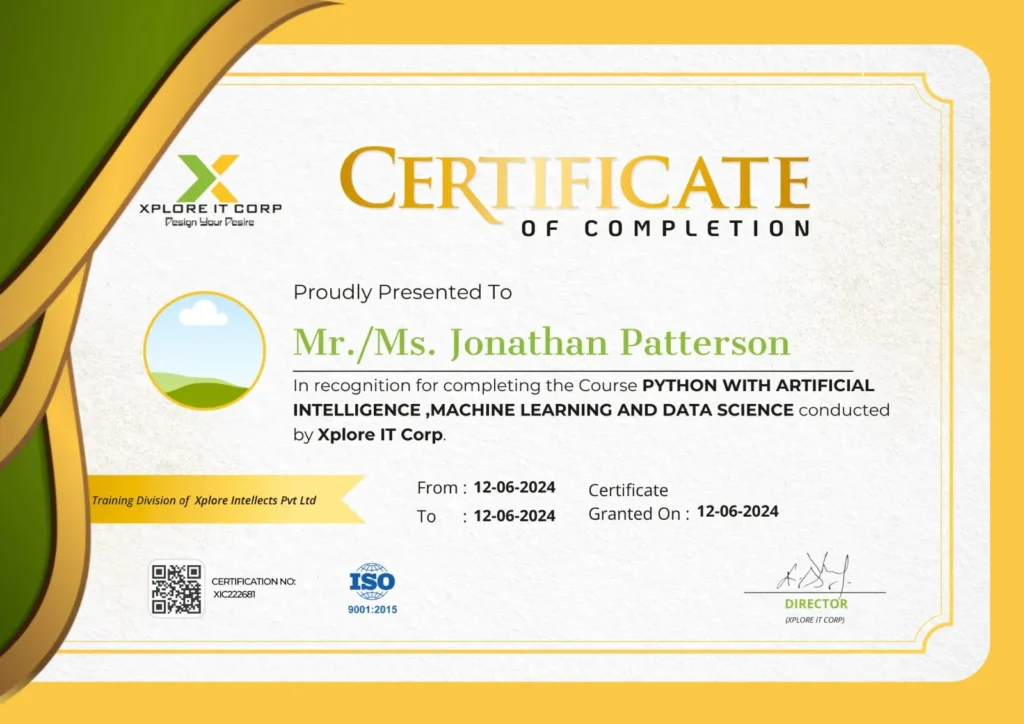
Industry-Validated Certification
Accredited by the Global Data Science Alliance and recognized by top tech employers worldwide.
Digital Verification
Includes a unique blockchain-verified ID that can be added directly to your LinkedIn profile.
Completion Criteria
Awarded upon submission of all 5 capstone milestones and passing the final technical assessment.

GOBINATH ARUMUGAM
Embedded Systems Engineer | IoT Architect | Technical Trainer
With a strong background in embedded technologies and electronics systems, Gobinath Arumugam delivers a practical, results-driven approach to Embedded Systems training, simplifying complex hardware and firmware concepts into clear, structured, and industry-ready skills.
Focused on transforming embedded systems knowledge into real-world applications through hands-on hardware projects, microcontroller programming, real-time systems development, and practical problem-solving.
13+ years
at Xplore IT Corp
150+
Institutions Reached
2000+ Batches
Trained Across India
50,000+
Students Trained








Course Syllabus
A comprehensive 12-week journey from basics to professional mastery.
- Basic Semiconductor Devices and Circuits PN Junction, BJT and
MOSFET - CMOS design technology
- Interpreting device datasheets (PN junction, BJT. MOSFET)
- Number Systems
- Combinational Network Design
- Interpreting the datasheet of a Logic Gate
- Designing with Mux. De mux. Decoders. Encoders
- Sequential Elements D Latch. D. Flip Flop
- Design of Sequential Systems Registers and Counters
- Introduction to Data Converters
- Fundamentals of Embedded System Design
- Design methodology
- Real-Time Embedded Systems
- Embedded System design challenges, Metrics & Goals
- Development environment
- Current market trends & Applications
- Careers and Job opportunities
- Introduction to C Programming
Structure of a C program
The C compilation process - Types and Operators
C base types
Precedence & Associativity
Arithmetic operation
Promotion & Typecasting - Control Flow
Logical expressions
Decision Making
Loops - Definitions and Declarations
Header files
Scope and lifetime
Storage Classes - Introduction to Pointers
Using pointers to access single dim arrays - Bit Manipulation
- Functions The Function as a logical program unit
Parameter passing by copy and reference
- Feature, Architecture. Applications
- PIC16f877a Datasheet and its uses
- Basic I/O operations, 4 digit LCD, etc…
- Timer, Counter
- Communication protocols
- UART, I2C. Serial Peripheral Interface
- ADC Analog to Digital Converters
- Introduction to various types of sensors
- Creating Simple Real Time Applications using PIC 16f877a
- Interfacing Codes with PIC development Boards
- Arrays, Pointers and Strings
Arrays as circular buffers
Relationship between pointers & arrays
Pointer arithmetic
C string handling. - Advanced Data types
Structures
Unions and Enums-Structures
Big & Little Endian representations
Bit-field structures - The C Pre-Processor-Macros
Conditional Compilation C Compilation process
pre-processor, compiler, assembler, linker stages
- KEIL
- Proteus 8
- MPLAB X IDE
- AVR Studio
- Introduction to Embedded System and
- ARM Processor
- ARM related Companies and its opportunities
- ARM processor family
- Application of ARM Processor
- Compiler
- Emulation and Debugging
- Difference between RISC & CISC
- LPC2148 ARM 7 microcontroller
- Features of LPC2148
- Block diagram of LPC2148
- Pin diagram of LPC2148
- Architectural overview
- On-chip flash program memory
- On-chip static RAM
- Crystal Oscillator
- PLL
- Reset and Wake-up Timer
- Brownout detector
- Code Security
- External interrupt input
- Pin Connect Block
- General Purpose Parallel I/O Features
8 Bit LED’s and switches
Relay and Buzzer
Seven Segment Led
Keypad
LCD
- General purpose timer/ External event counters Features
Interfacing Timer and Counter Operation - 10-bit ADC Features
Interfacing Temperature Sensor LM35 - 10-bit DAC Features
Interfacing DAC - UARTS Features
- Serial Communication
- Interrupt Controller
- Interrupt Sources
- External Interrupt
- 12C-bus serial I/O Controller
- SPI-Serial I/O Controller
- Watchdog timer
- Real Time Clock
- Pulse Width Modulator
- RTOS
- Introduction about PCB
- Combinational and sequential Circuits
- Basic circuit designing
- Schematic design and board level designing
- Bluetooth (Programming)
- RFID (Programming)
- GSM.GPS (Interfacing & Programming)
- Other real time applications
Objective: Understand the architecture that revolutionized modern AI.
- The Transformer Revolution: Why RNNs failed
- Attention Mechanism: Query–Key–Value Concept
- Self-Attention and Multi-Head Attention
- Encoder–Decoder Architecture
- Positional Encoding & Token Embeddings
- Scaling Transformers for Long Context
- Transformers in Vision (ViT), Text (BERT, GPT), and Multimodal AI