
Data Science Professional Program
Master core Data Science concepts, statistical analysis, and data-driven problem solving through real-world projects and hands-on labs to build industry-ready data science skills.
Professional Certification
Upon successful completion, you will receive an industry-recognized credential.
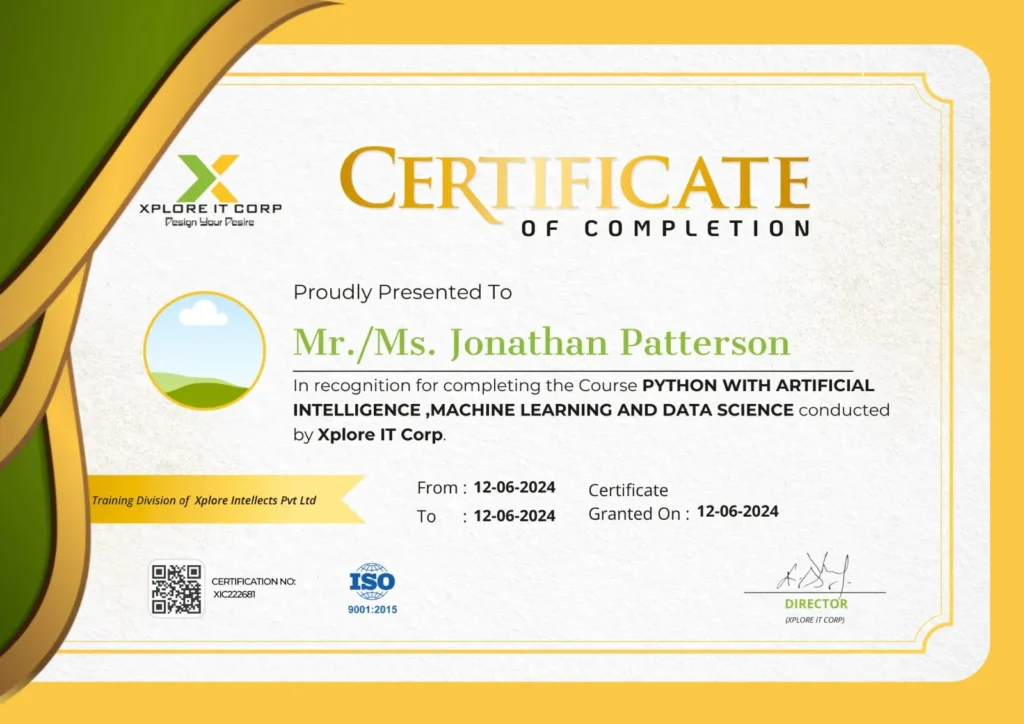
Industry-Validated Certification
Accredited by the Global Data Science Alliance and recognized by top tech employers worldwide.
Digital Verification
Includes a unique blockchain-verified ID that can be added directly to your LinkedIn profile.
Completion Criteria
Awarded upon submission of all 5 capstone milestones and passing the final technical assessment.

GOBINATH ARUMUGAM
Chief Technology Officer | AI, ML & Data Science Trainer
With a strong background in software and data technologies, Gobinath Arumugam delivers a practical, results-driven approach to Data Science training, simplifying complex data concepts into clear, structured, and job-ready skills.
Focused on transforming Data Science knowledge into real-world applications through hands-on projects, data analysis, and practical problem-solving.
13+ years
at Xplore IT Corp
150+
Institutions Reached
2000+ Batches
Trained Across India
50,000+
Students Trained





Course Syllabus
A comprehensive 12-week journey from basics to professional mastery.
Gives beginners the base they need before jumping into Python and full
stack AI.
- Programming Logic: Flowcharts & Pseudocode
- Refresher in C & C++ Fundamentals
- Basics of Web: HTML5, CSS3, JavaScript, Bootstrap
- Installing Python (Anaconda, venv, VS Code, Jupyter)
- IDE Setup: PyCharm, VS Code, Jupyter Notebook
- What Python is and where it’s used (AI, ML, Web, Automation, etc.)
- History, Versions, Advantages
- Compilation vs. Interpretation
- Writing and executing Python programs
- Understanding indentation, blocks, and comments
- Dynamic Typing & Memory Management
- Numeric, String, Boolean, List, Tuple, Set, Dictionary
- Type Casting and Type Checking
- Input/Output Operations
- Arithmetic, Relational, Logical, Assignment, Bitwise
- Membership & Identity Operators
- Operator Precedence
- Conditional Statements (if, elif, else)
- Loops: for, while, Nested Loops
- Loop Controls (break, continue, pass)
- Using else with loops
- Strings, Lists, Tuples, Sets, Dictionaries
- Indexing, Slicing, CRUD Operations
- Comprehensions & Nested Comprehensions
- Advanced Data Structure Modules: collections, itertools
- Defining & Calling Functions
- Arguments (positional, keyword, default, *args,
**kwargs) - Return Statements & Scope (Local, Global, Nonlocal)
- Anonymous Functions (Lambda)
- Higher-Order Functions (map, filter, reduce)
- Decorators & Closures
- Errors vs. Exceptions
- Try-Except-Else-Finally
- Raising Exceptions
- Custom Exception Classes
- Logging & Debugging
- Classes, Objects, Constructors, Destructors
- Instance, Class, and Static Variables
- Encapsulation, Abstraction, Inheritance, Polymorphism
- Method Overloading & Overriding
- Magic Methods (__init__, __str__, etc.)
- Real-world Project: Inventory or Student Management System
- Reading/Writing Files (Text, Binary, CSV)
- File Pointers, Modes, and Context Managers (with)
- Working with JSON Files
- Exception Handling in File Operations
- Creating and Importing Custom Modules
- Standard Libraries (os, sys, math, datetime, random, shutil)
- Installing and Managing Packages (pip, venv)
- Understanding Namespaces and __init__.py
- Iterators and Generators
- Regular Expressions (Pattern Matching & Validation)
- Command-Line Arguments (sys, argparse)
- Working with the OS, Subprocess, and Environment Variables
- The threading and multiprocessing modules
- Thread Lifecycle and Synchronization
- Client-Server Communication (Socket Programming)
- Mini Project: Chat Application
- Tkinter Widgets, Layouts, and Events
- PyQt5 & Qt Designer Integration
- Signals, Slots, and Database Handling
- Project: Desktop App (Expense Tracker / Student Database
Manager)
- SQLite3 & MySQL with Python
- CRUD Operations and Transactions
- Using SQLAlchemy ORM
- Connecting Databases with Flask and Django
- Database Design and Relationships
Frontend Development
- HTML5, CSS3, and Bootstrap
- JavaScript (ES6+), DOM Manipulation, Events
- AJAX & Fetch API
- Optional: React.js or Vue.js Basics for Modern UI
- Flask Installation & Setup
- Routing, Templates, and Static Files
- Form Handling & Validation
- REST API Development with Flask
- Connecting Flask with Databases (SQLite/MySQL)
- JWT Authentication
- Deploying Flask Apps (Render, AWS Elastic Beanstalk)
Why Django?
Django is a high-level Python web framework that promotes rapid
development and clean, pragmatic design. It follows the MVT (Model–
View–Template) architecture and is ideal for building scalable, secure,
and maintainable web applications.
- Introduction to MVT Architecture
- Installing Django and Setting Up Virtual Environments
- Creating a Project and an App
- Understanding Django Folder Structure
- Models:
Defining Models and Fields
Database Migrations (makemigrations, migrate)
QuerySets, Filters, Lookups
Model Relationships (One-to-One, One-to-Many, Many-to-Many) - Views:
Function-based Views (FBVs)
Class-based Views (CBVs)
HTTP Request and Response Cycle - Templates:
HTML Templates with Django Templating Engine
Template Inheritance and Filters
Static and Media Files Handling
- Django Forms and ModelForms
- Validation and CSRF Protection
- File Uploads
- Handling POST Requests
- User Authentication (Signup, Login, Logout)
- Sessions & Cookies
- Custom User Models
- Role-based Access Control (Admin, Users, Staff)
- Customizing the Django Admin Interface
- Adding and Editing Data from Admin Panel
- Admin Filters and Search
- Performing CRUD Operations through ORM
- Query Optimization
- Using Related Managers and Reverse Relations
- Creating REST APIs
- Serializers and ViewSets
- Authentication & Permissions
- Token-Based and JWT Authentication
- API Testing with Postman
- Environment Configuration and .env Setup
- Debug vs. Production Mode
- Deploying Django Apps on AWS / Render / Heroku
- Integrating Django with Nginx and Gunicorn
- Dockerizing a Django Application
- Full Stack Project (e.g., E-Commerce Site, Job Portal, Student
Management System) - End-to-End: Frontend → Backend → Database → API → Deployment
Objective: Build foundational understanding of how AI, ML, and DS
connect to each other.
- What is Artificial Intelligence?
- AI vs. Machine Learning vs. Deep Learning vs. Data Science
Branches of AI: - Symbolic AI (Rule-based systems)
- Statistical AI (Machine Learning)
- Cognitive AI (Deep Learning, LLMs)
- AI & DS Lifecycle: Problem → Data → Model → Evaluate → Deploy →
Feedback - Overview of Tools: Python, Jupyter, NumPy, Pandas, Scikit-learn,
TensorFlow, Keras, PyTorch - Use Cases: Healthcare, Finance, Automation, Chatbots, Vision,
Robotics
End-to-End “Hello AI” Example — Simple Prediction
Model
Objective: Learn how to handle, analyze, and visualize data effectively
- Data Types (Structured, Semi-structured, Unstructured)
- Loading and cleaning datasets (CSV, JSON, SQL, APIs)
- Handling missing values, duplicates, outliers
- Encoding categorical data
- Feature scaling (Normalization, Standardization)
- Feature engineering and transformation
- Descriptive Statistics: Mean, Median, Variance, Correlation
- Data Visualization:
Matplotlib for static visualizations
Seaborn for statistical plots
Plotly for interactive dashboards - Building insights from patterns and relationships
Data Cleaning and EDA Report on Real Dataset
Objective: Understand the math that drives ML and DL algorithms.
- Linear Algebra: Vectors, Matrices, Eigenvalues, Operations
- Probability: Bayes’ Theorem, Conditional Probability, Distributions
- Statistics: Sampling, Hypothesis Testing, p-values, Confidence
Intervals - Calculus: Derivatives, Gradients, Optimization, Gradient Descent
- Optimization Concepts: Cost Function, Learning Rate, Convergence
Linear Regression from scratch using Gradient
Descent
Objective: Learn classical ML models using the Scikit-learn library.
- Introduction to Scikit-learn Ecosystem
- Data Preprocessing Pipelines
- Supervised Learning Algorithms:
- Regression: Linear, Ridge, Lasso, Polynomial
- Classification: Logistic Regression, Decision Tree, Random
- Forest, SVM, k-NN, Naïve Bayes
- Unsupervised Learning Algorithms:
- Clustering: K-Means, Hierarchical, DBSCAN
- Dimensionality Reduction: PCA, LDA
- Model Evaluation Metrics: Accuracy, Precision, Recall, F1, ROC-AUC
- Ensemble Learning: Bagging, Boosting, XGBoost, LightGBM
- Model Saving and Deployment (pickle, joblib)
- Credit Risk Prediction using Scikit-learn
Objective: Build and train deep neural networks for image and text data.
- Building Sequential & Functional Models
- Activation Functions and Optimizers
- Loss Functions and Metrics
- Dropout & Regularization
- Transfer Learning using Pre-trained Models (VGG, ResNet)
- Callbacks and Early Stopping
- Tensors and Graph Execution
- TensorBoard Visualization
- Custom Training with Gradient Tape
- Dataset Pipelines and TFRecords
- TensorFlow Serving for Model Deployment
Image Classifier using Keras + TensorFlow
Objective: Learn to implement neural networks from scratch with
PyTorch.
- Introduction to PyTorch Tensors & Autograd
- Creating Custom Models using nn.Module
- Datasets and DataLoaders
- Training Loops, Loss Functions, and Optimizers
- GPU Acceleration (CUDA)
- Model Checkpointing and Loading
- PyTorch Lightning (High-level API)
- Transfer Learning & Fine-tuning
- TorchServe for Deployment
Digit Recognition using PyTorch (MNIST Dataset)
Objective: Train AI systems to understand and process human language.
- Text Cleaning: Tokenization, Stopwords, Lemmatization
- Bag-of-Words and TF-IDF Representation
- Word Embeddings: Word2Vec, GloVe, FastText
- Named Entity Recognition (NER)
- Sequence Modeling: RNN, LSTM, GRU
- Sentiment Analysis and Text Classification
- Topic Modeling: LDA and Transformers for NLP
Sentiment Analysis on Social Media Data
Objective: Understand, fine-tune, and deploy modern transformer-based
LLMs.
LLM Foundations
- How LLMs Work: Tokens, Embeddings, Attention Mechanism
- Transformer Architecture: Encoder-Decoder, Multi-Head Attention,
Feedforward Layers - Pretraining Objectives: Masked LM (BERT), Causal LM (GPT)
- Positional Encoding & Context Windows
- BERT, GPT, T5, LLaMA, Falcon, Mistral, Gemma, Claude, etc.
- Tokenization: BPE, WordPiece, SentencePiece
- Fine-tuning LLMs: Full vs. Parameter-efficient (LoRA, PEFT,
Adapters) - Prompt Engineering Techniques (Zero-shot, Few-shot, Chain-ofthought)
- Inference & Decoding: Greedy, Beam Search, Top-k, Top-p Sampling
- Evaluation Metrics: Perplexity, BLEU, ROUGE, BERTScore
- Instruction-tuning for domain-specific tasks
- Retrieval-Augmented Generation (RAG)
- Building AI Assistants using LangChain
- Vector Databases (FAISS, Pinecone) for Memory
- Multimodal LLMs (text + image/audio/video inputs)
Domain-specific ChatGPT-style Assistant using
LangChain + LLaMA
Objective: Explore models that can generate new data — text, images,
or audio.
- Evolution: From GANs to Diffusion Models to LLMs
- Generative Models:
GAN (Generator + Discriminator)
Variational Autoencoders (VAE)
Diffusion Models (Stable Diffusion Overview) - Text-to-Image Systems (DALL·E, Midjourney, Stable Diffusion)
- Prompt Engineering for Generative Systems
- Responsible & Ethical AI Practices
Text-to-Image Generator using Diffusers
Objective: Understand the architecture that revolutionized modern AI.
- The Transformer Revolution: Why RNNs failed
- Attention Mechanism: Query–Key–Value Concept
- Self-Attention and Multi-Head Attention
- Encoder–Decoder Architecture
- Positional Encoding & Token Embeddings
- Scaling Transformers for Long Context
- Transformers in Vision (ViT), Text (BERT, GPT), and Multimodal AI
Build a Transformer-based Text Classifier
Objective: Build pipelines to feed AI systems with reliable data.
- Data Warehousing & ETL Concepts
- SQL and NoSQL (MongoDB, Redis)
- Stream Processing with Kafka
- Workflow Automation (Airflow, Prefect)
- Big Data Tools Overview (Spark, Hadoop)
- Integration with ML Pipelines
Real-time Data Pipeline for Prediction Model
Objective: Learn to build autonomous, reasoning AI systems that can
plan, act, and learn.
- What are AI Agents? Difference from Chatbots
- Components of an Agent:
Perception (Input Understanding)
Reasoning (Goal-Oriented Thought Process)
Action (Tool or API Execution)
Memory (Short-term & Long-term Context) - Frameworks for Building Agents:
LangChain Agents
OpenAI Function Calling / Tool Use
AutoGPT & BabyAGI Concepts
Multi-Agent Collaboration - Agents with External Tools:
Web Search, APIs, Databases, File Systems - Memory Systems with Vector Stores
Safety, Alignment, and Guardrails in Autonomous AI - Mini Project
AI Research Assistant Agent using LangChain +
OpenAI Tools
Objective: Bring it all together into a real-world deployment-ready
project. Options:
- Data Science Dashboard (EDA → ML → Visualization)
- Deep Learning Image Classifier (TensorFlow or PyTorch)
- NLP Chatbot using Transformer LLM (BERT/GPT-based)
- RAG-based GenAI Assistant using LangChain + VectorDB
- End-to-End MLOps System with Docker + AWS
- Predictive Analytics Pipeline for Business Insight